In short. Quartz is purified in stages. Selective mining and sorting remove visibly contaminated rock, and crushing frees the mineral grains. Magnetic separation removes iron-bearing minerals and flotation removes aluminium-bearing silicates such as mica. Calcination, acid leaching and hot chlorination attack surface films, fracture fillings and fluid inclusions. Elements built into the quartz crystal, such as lithium, boron, sodium, phosphorus and titanium, are hard to remove, so the starting quartz sets the limit.
What makes quartz impure?
Natural quartz is silicon dioxide with other material mixed in at four levels. Lin, Pei and Lei studied hydrothermal vein quartz from Hubei, China, and found mica (muscovite), hematite, apatite and fluid inclusions. Its main impurity elements were aluminium at 353 µg/g, potassium at 118 µg/g and iron at 61.2 µg/g.
| Impurity | Where it sits | Examples |
|---|---|---|
| Mineral inclusions | Along grain boundaries, in cracks and inside grains | Mica, hematite, apatite |
| Surface films | On particle surfaces and in fractures | Iron oxide films that physical methods struggle to remove |
| Fluid inclusions | Micron-size pockets of gas and liquid inside grains | Hydrogen, sodium and other alkali and alkaline-earth elements |
| Lattice impurities | Inside the crystal structure | Aluminium, lithium, boron, sodium, titanium |
What are the main stages?
Lin and co-authors group the technologies for high-grade quartz into four families: pre-processing, physical processing (magnetic separation and flotation), chemical treatment (acid leaching and hot chlorination) and thermal treatment (calcination).
| Stage | What it does | What it removes |
|---|---|---|
| Selective mining and sorting | Keeps the cleanest rock and rejects stained or mixed pieces | Host rock and visibly contaminated quartz |
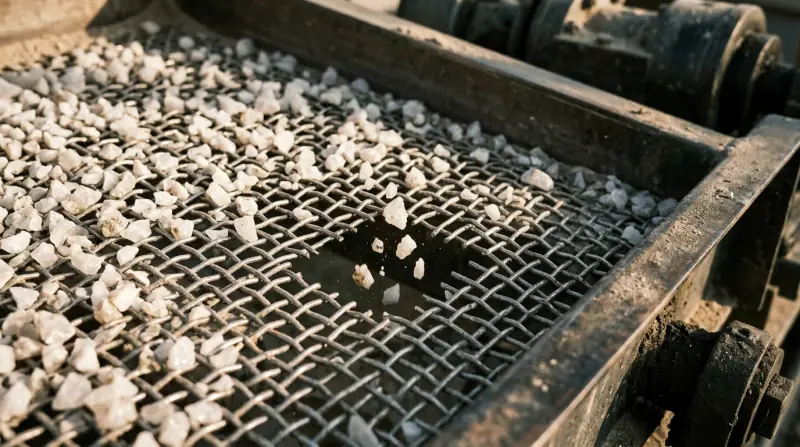
| Crushing, milling and screening | Reduces the quartz to the size the next step needs | Frees mineral inclusions; can add iron from wear in the mill |
| Magnetic separation | Pulls magnetic particles out of the stream | Iron-bearing minerals |
| Flotation | Floats unwanted minerals off with reagents in water | Aluminium-bearing silicates such as feldspar and mica |
| Calcination | Heats the quartz to high temperature | Volatiles in fluid inclusions; cracks open trapped minerals |
| Acid leaching | Dissolves exposed minerals and surface films | Iron films, exposed mica, hematite and apatite |
| Hot chlorination | Treats quartz at high temperature in a chlorinating atmosphere | Used in high-purity quartz processing; details vary by plant |
Magnetic separation and flotation each remove only certain minerals, so physical routes run long. Leaching removes several impurities at once. Hydrofluoric acid is common in leaching but is hazardous and hard on the environment, so Lin and co-authors tested fluoride-free pressure leaching after calcination at 900 °C for five hours. That route removed 88.2% of the aluminium, 99.0% of the potassium and 98.1% of the iron in their quartz.
Work on Sri Lankan vein quartz by Pathirage and co-authors points the same way at the start of the chain: iron and other critical trace elements need watching at each step, fine grinding can pick up iron, and selective mining with quality control during mining, transport and processing matters.
Geoscience Australia notes that ANSTO provided processing know-how for high-purity quartz, in particular high-temperature chlorination, for future Australian projects.
What is hard to remove?
Elements held in the quartz lattice. In the same study, removal rates for lithium, boron, sodium, phosphorus and titanium were not high, because part of each is likely held in the crystal lattice. Leaching does little to that part. The starting quartz therefore sets the limit, so a purifier tests a feedstock for these elements before committing to it. See Sri Lanka’s vein quartz.
What counts as high-purity quartz?
The U.S. Geological Survey defines high-purity quartz as natural quartz with less than 100 parts per million of total impurities, and notes that some products contain less than 10 ppm. It is used in electronics, fibre-optic cables and fused-quartz crucibles. The USGS puts ground high-purity quartz at US$500 to 12,000 a tonne in 2025. For the N grades, see Quartz purity grades.
Where does dry-processed feedstock fit?
Purifiers start from selected, sized quartz. A consistent feed, with SiO2, Fe2O3, Al2O3, TiO2, CaO, Na2O and K2O reported on every batch COA, helps them plan. Lattice elements such as lithium and boron need their own tests; we report other trace elements on request, by agreed method. That is the part of the chain we supply: quartz grits and powder, processed dry, with a batch Certificate of Analysis. For how to qualify a source, see Sourcing quartz feedstock.
Common questions
How is quartz purified?
In stages: selective mining and sorting, crushing and screening, magnetic separation and flotation, then calcination, acid leaching and in some plants hot chlorination. Each stage removes a different kind of impurity.
Can any quartz be purified to high purity?
No. Elements held in the crystal lattice, such as lithium, boron, sodium and titanium, are hard to remove by leaching, so the result depends on the starting quartz.
Where is pure quartz found?
High-purity quartz deposits are rare. The USGS compares new deposits with high-purity quartz from Spruce Pine, North Carolina. Every new source has to be tested for lattice elements.
Sources
- Lin, M., Pei, Z. and Lei, S. (2017), “Mineralogy and Processing of Hydrothermal Vein Quartz from Hengche, Hubei Province (China)”, Minerals 7(9), 161
- Pathirage, S.S. et al. (2019), “Production of industry-specific quartz raw material using Sri Lankan vein quartz”, Environmental Earth Sciences 78, 58
- Geoscience Australia, High Purity Silica
- U.S. Geological Survey, Mineral Commodity Summaries 2026: Quartz (high-purity and industrial cultured crystal)
Industry context. Figures on this page come from the sources listed and describe trade data, published standards or research. They are not a specification for our material. Our values are on each batch COA. Published October 2026.