In short. Glass makers buy silica sand on iron, grain size and heavy minerals. Typical iron limits run from below 0.035% Fe2O3 for colourless containers to 0.25–0.4% for coloured containers, and a common grain size window is 0.1 to 0.6 mm. Crushed quartz fits a window like this only when screening removes both the oversize and the fines.
What does quartz do in glass?
Silica (SiO2) is the main glass-forming oxide. Ordinary soda-lime-silica glass, used for containers and windows, is 70 to 74% SiO2. Most of that silica arrives as silica sand, or as quartz crushed and screened to sand sizes.
What do glass makers check?
| Parameter | Typical industry figure | Source |
|---|---|---|
| Fe2O3, colourless container glass | Below 0.035% | BGS (2020) |
| Fe2O3, flat glass | 0.01 to 0.1% | BGS (2020) |
| Fe2O3, coloured container glass | 0.25 to 0.4% | BGS (2020) |
| Low-iron glass for solar modules | Glass capped at 150 ppm Fe2O3 under Chinese standards; zircon and chromite in the sand kept to 5 ppm or less | Chowdhury et al. (2025) |
| SiO2, colourless (flint) glass | 98.5 to 99% | BGS, Mitchell |
| Al2O3, colourless (flint) glass | Up to 0.5% | BGS, Mitchell |
| Grain size | 0.1 to 0.6 mm | BGS, Mitchell |
| Refractory heavy minerals: chromite, zircon, ilmenite, rutile, corundum | Limited by the buyer | BGS, Mitchell |
| Colourants: nickel, copper, cobalt | Limited by the buyer | BGS, Mitchell |
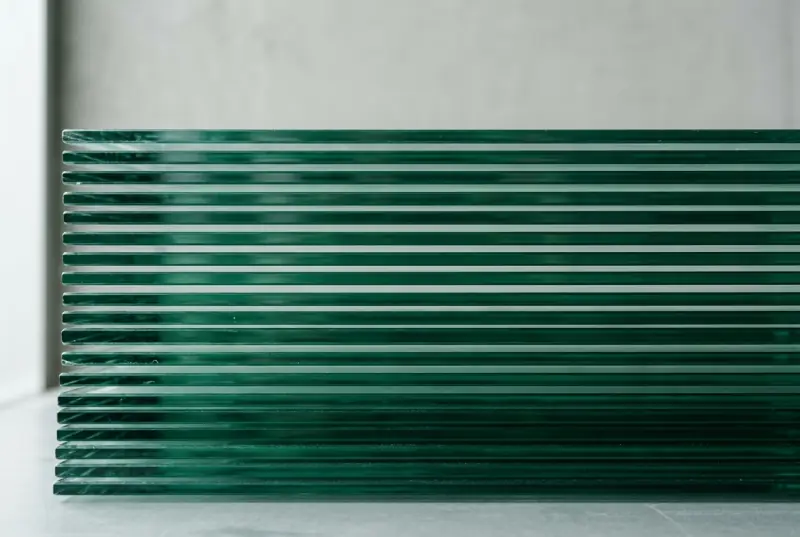
The glass sets the iron limit, not the sand. Iron tints glass green, so the clearer the product, the lower the limit. Refractory grains melt far above glass-making temperatures and can survive as defects in the glass.
Which standards and test methods apply?
- ASTM C146, Standard Test Methods for Chemical Analysis of Glass Sand. It covers SiO2, Fe2O3, TiO2, Cr2O3, ZrO2, loss on ignition, alkalis and trace elements.
- ASTM C429, Sieve Analysis of Raw Materials for Glass Manufacture.
- BS 2975, Sampling and analysis of glass-making sands: Part 1 for sampling and physical tests, Part 2 for chemical analysis.
Name the method next to every limit. XRF and ICP methods have different detection limits, as our quality page explains.
Where does crushed vein quartz fit?
- Crushing makes fines. A glass size window is tight at both ends, so screening and classification decide whether a product fits.
- Crushers and mills wear, and worn steel adds iron. Magnetic separation is a common way to take it back out.
- Heavy minerals are a test result, not a geological promise. Ask for Cr2O3 and ZrO2 by ASTM C146 rather than assume a vein is free of them.
What should a glass sand request include?
- The glass type: colourless or coloured container, or flat glass.
- Limits for Fe2O3, Al2O3, TiO2, Cr2O3 and the alkalis, with the analysis method.
- The size window: the most you accept over 600 µm or 1 mm, and under 125 µm, with the sieve standard.
- Any limit on refractory heavy-mineral grains.
- Moisture, lot size per COA, monthly volume and destination port.
The mesh-to-micron table converts sieve numbers to openings.
What we supply
We supply quartz grits crushed and screened from Sri Lankan vein quartz to the size window you set. Each batch ships with a Certificate of Analysis reporting SiO2, Fe2O3, Al2O3, TiO2, CaO, Na2O, K2O, moisture and particle-size distribution. Other trace elements, such as Cr2O3, are reported on request by an agreed method. Send your specification and we tell you what we can hold from shipment to shipment.
Sources
- British Geological Survey, Mineral Planning Factsheet: Silica Sand (2020)
- British Geological Survey, Mitchell, "It’s in the sand"
- Chowdhury et al., Sustainable Energy & Fuels, Royal Society of Chemistry (2025)
- ASTM C146-26, Standard Test Methods for Chemical Analysis of Glass Sand
- ASTM C429, Sieve Analysis of Raw Materials for Glass Manufacture
- BSI, BS 2975-1, Sampling and analysis of glass-making sands: sampling and physical testing
- BSI, BS 2975-2, Sampling and analysis of glass-making sands: chemical analysis
- Xie et al. (2023), review of quartz purification routes, Minerals and Mineral Materials
- US Bureau of Mines IC 7139, Grinding pebbles and tube-mill liners (1940)
Industry context. Figures on this page describe common industry practice and published standards, from the sources listed. They are not a specification for our material. Our values are on each batch COA. Published October 2026.