In short. Silica ramming mass lines coreless induction furnaces. It is a dry, graded mix of crushed quartz or quartzite that sinters in place. One published buyer specification asks for SiO2 of 98.6% or more, Al2O3 of 0.8% or less and free iron of 0.05% or less, graded 0 to 4 mm for cast iron. A new source is proven in a furnace trial.
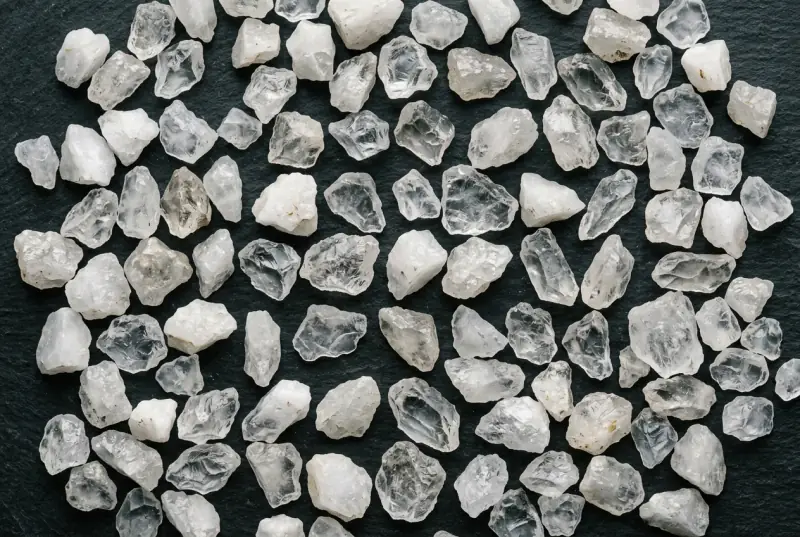
How is quartz used in refractories?
Ramming mass. A dry, graded mix of crushed quartz or quartzite is rammed into a coreless induction furnace and sintered in place to form the lining.
Silica bricks. Quartzite with about 2% lime is fired at about 1450 to 1500 °C. Firing converts quartz to tridymite and cristobalite. The more quartz a brick still holds, the more it grows in service.
What do ramming mass buyers check?
| Parameter | Requirement |
|---|---|
| SiO2 | 98.6% or more |
| Al2O3 | 0.8% or less |
| Free iron | 0.05% or less |
| Grading for cast iron, 0 to 4 mm | 23–28% between 4 and 1 mm; 45–55% between 1 mm and 150 µm; 23–28% under 150 µm |
| Grading for steel | 0 to 7 mm |
| Rated temperature | 1550 °C for iron, 1700 °C for steel |
| Documents | A test certificate with every consignment |
The same specification notes that India has no national product specification for ramming mass. A technical reference gives typical values of SiO2 98.9% or more, Al2O3 0.6% or less and Fe2O3 0.2% or less, for use up to 1600 °C.
What do silica brick standards set?
ASTM C416 classifies silica refractory brick. Its scope limits Al2O3 to below 1.50%, TiO2 below 0.20%, iron oxide below 2.50% and CaO below 4.00%. It ranks bricks by a flux factor, the Al2O3 content plus twice the alkali content. Type A bricks have a flux factor of 0.50 or less.
Why do phase changes matter?
Quartz turns from alpha to beta at 573 °C, with a volume increase of about 0.8%. At higher temperatures it converts to cristobalite, with a change of about 15%. A lining or brick that still holds unconverted quartz keeps growing in service.
How fast a quartz converts affects lining strength, expansion and slag penetration. One study reports that, in practice, a quartzite lining pretreated at 800 °C lasts 300 to 350 melts at up to 1500 °C. Prove a new source in a furnace trial.
Which standards and test methods apply?
- ASTM C416, Standard Classification of Silica Refractory Brick.
- IS 10047:2023, Refractory Plastic and Ramming Mass: Method of Test (India).
- ISO 12677:2011, chemical analysis of refractory products by XRF, fused cast bead method.
Where does crushed vein quartz fit?
- Ramming mass is graded crushed quartz, so the product form matches.
- Free iron limits are tight, and crushers add iron as they wear. Magnetic separation and low-wear crushing matter.
- How vein quartz converts compared with quartzite has to be shown in your furnace, not assumed.
What should a ramming mass request include?
- SiO2, Al2O3, Fe2O3 and free iron limits, with the method.
- For bricks, alkalis or the flux factor.
- The grading: 0 to 4 mm or 0 to 7 mm, with the share in each band.
- Moisture.
- Furnace type, alloy and operating temperature.
- Monthly volume and destination port.
What we supply
We supply quartz grits crushed and screened from Sri Lankan vein quartz into the fractions you set. Each batch ships with a Certificate of Analysis reporting SiO2, Fe2O3, Al2O3, TiO2, CaO, Na2O, K2O, moisture and particle-size distribution. Tell us how you measure free iron, and we tell you whether we can report it.
Sources
- IspatGuru (2015), silica refractories
- IspatGuru (2018), induction furnace lining with silica ramming mass
- BHEL specification AA53614 Rev 02, silica ramming mass (2014)
- ASTM C416, Standard Classification of Silica Refractory Brick
- Bureau of Indian Standards, IS 10047:2023, Refractory Plastic and Ramming Mass: Method of Test
- ISO 12677:2011, chemical analysis of refractory products by XRF
- Břuska et al., Archives of Foundry Engineering (2012), dilatation of foundry sands
- Kukartsev et al., Metals (2022), quartzite induction furnace linings
- China’s Refractories (2025), quartzite characteristics and ramming mass performance
Industry context. Figures on this page describe common industry practice and published standards, from the sources listed. They are not a specification for our material. Our values are on each batch COA. Published October 2026.