In short. Foundries specify silica sand by AFS grain fineness number, the spread across adjacent sieves, clay content and grain shape. Published specifications ask for sub-angular to rounded grains, because angular grains pack loosely and take more binder. That makes crushed vein quartz a weak fit for mould and core sand. Silica flour for mould coatings is specified by fineness and chemistry instead.
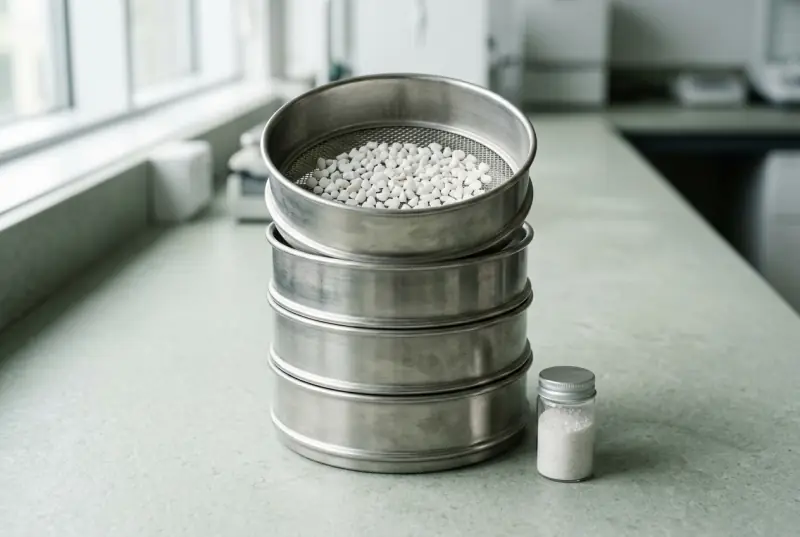
What does silica sand do in a foundry?
Silica sand is the refractory aggregate that forms moulds and cores. Green sand is bonded with clay. Chemically bonded sand uses resin or other binders.
What do foundries check?
| Parameter | Typical industry figure | Source |
|---|---|---|
| SiO2 | 96% or more for washed and dried sand; above 98% for IS 1987 Grade A | SFSA 12-61; IS 1987 |
| Fe2O3 | 0.50% or less | SFSA 12-61 |
| CaO | 0.60% or less | SFSA 12-61 |
| AFS clay | 0.75% or less for AFS 80 and coarser; 1.50% for finer sand | SFSA 12-61 |
| Moisture | 0.50% or less | BHEL HY 53698; SFSA 12-61 for shipments in closed equipment |
| Grain fineness | AFS 40 to 50 in one buyer specification | BHEL HY 53698 |
| Spread across sieves | At least 72% (BHEL) to 85% (IS 1987) on three adjacent sieves | BHEL HY 53698; IS 1987 |
| Grain shape | Sub-angular to rounded | IS 1987; BHEL HY 53698 |
For chemically bonded sand, foundries also test acid demand value (ADV) and pH, because both change how fast acid- or base-catalysed binders cure. Pure silica has an ADV of zero and a pH near 7.
Why does thermal expansion matter?
Quartz changes from its alpha to its beta form at 573 °C, with a volume increase of about 0.8%. Bonded silica sand expands as it heats towards that point and loses volume above it. That loss of volume above 573 °C is the main cause of veining defects in castings. It applies to any quartz sand, crushed or natural.
Which standards and test methods apply?
- AFS Mold & Core Test Handbook, 5th edition (2020), the American Foundry Society’s handbook of mould and core sand tests.
- SFSA 12-61, Steel Founders’ Society of America specification for washed and dried silica sand.
- IS 1987:2002, High Silica Sand for Use in Foundries (India), with IS 1917 for chemical analysis and IS 1918 for physical tests.
- IS 3339:2024, silica flour for foundry use (India).
Where does crushed vein quartz fit?
As mould and core sand, it is a weak fit. Angular grains pack less densely and flow less well than rounded grains. A 1946 Canadian government study traced excessive core oil demand to angular grains, which left 36.7% voids against 31.6% for a sub-angular to round sand.
Silica flour is different. IS 3339:2024 sets SiO2 at 98% or more, moisture at 1% or less, all passing 150 µm with at least 95% passing 75 µm, and a fusion point of 1700 °C or more. It sets no grain shape. Milled quartz is a candidate there, and your trials decide.
What should a foundry request include?
- Moulding sand or coating flour.
- For sand: the AFS grain fineness target and tolerance, the share on three or four adjacent sieves, and grain shape.
- AFS clay and moisture.
- SiO2, Fe2O3, CaO and loss on ignition, with the method.
- ADV and pH, for chemically bonded sand.
- For flour: fineness at 150 and 75 µm, and fusion point.
What we supply
We supply quartz powder milled to the fineness you set, and quartz grits in screened fractions. Each batch ships with a Certificate of Analysis reporting SiO2, Fe2O3, Al2O3, TiO2, CaO, Na2O, K2O, moisture and particle-size distribution. Tell us whether you need moulding sand or coating flour, and we tell you plainly whether our material fits.
Sources
- Steel Founders’ Society of America, specification 12-61, washed and dried silica sand
- Bureau of Indian Standards, IS 1987:2002, High Silica Sand for Use in Foundries
- BHEL specification HY 53698 Rev 02, foundry silica sand (2019)
- Foundry Management & Technology (2017), ADV and pH testing for mould and core sand
- Modern Casting (2014), sand expansion and veining
- Břuska et al., Archives of Foundry Engineering (2012), dilatation of foundry sands
- Rana et al., Archives of Foundry Engineering (2023), sand grain shape
- Canada, Ore Dressing and Metallurgical Laboratories (1946), moulding sands
- Bureau of Indian Standards, IS 3339:2024, silica flour for foundry use
- American Foundry Society, Mold & Core Test Handbook, 5th edition (2020)
Industry context. Figures on this page describe common industry practice and published standards, from the sources listed. They are not a specification for our material. Our values are on each batch COA. Published October 2026.