In short. Silica flour is quartz milled to a powder and used as an extender and filler. Buyers specify the particle-size distribution (D50, D90 and top cut), oil absorption, whiteness, moisture and Fe2O3. ISO 3262-13:2023 covers ground natural quartz as an extender, and ISO 787 sets the common test methods.
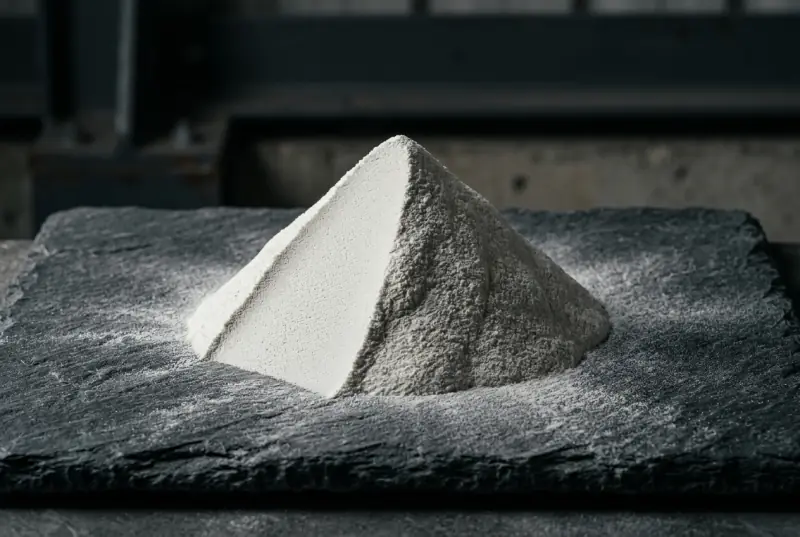
What does quartz do as a filler?
Quartz is hard (Mohs 7), chemically stable and does not burn. As a filler it adds volume and stiffness, and it raises wear resistance in floors.
Coarser quartz sand goes into resin floors too. Sika’s aggregate guide for resin flooring lists products from 0.03–0.3 mm to 0.1–1.2 mm.
What do filler buyers check?
- The particle-size distribution: D50, D90 and top cut, by laser diffraction or sieve residue.
- Oil absorption, a measure of how much binder the filler takes up.
- Whiteness and colour, as L* and b*.
- Moisture and pH.
- Fe2O3, because iron affects colour.
Which standards and test methods apply?
- ISO 3262-13:2023, Extenders, Part 13: natural quartz (ground).
- ISO 3262-21:2023, Extenders, Part 21: silica sand (unground natural quartz).
- ISO 787-5:2026, oil absorption value.
- ISO 787-7:2009, residue on sieve, water method.
- ASTM D281, oil absorption by spatula rub-out.
Where does crushed vein quartz fit?
- Milling is where iron comes in. Steel media and liners wear, and pebble or silica-lined mills have long been used to limit it. Iron lowers whiteness, so ask for Fe2O3 and L* together.
- Fine quartz powder is respirable crystalline silica once airborne. Exposure limits apply: 50 µg/m³ in the US and 0.1 mg/m³ in the EU, both over 8 hours. Plan dust control where the powder is handled.
What should a filler request include?
- D50, D90 and top cut, with the test method.
- Oil absorption, with the method: ISO 787-5 or ASTM D281.
- Whiteness and colour limits.
- Moisture, pH and Fe2O3 limits.
- For flooring aggregate, the size band in millimetres and the dryness you need.
- Packing, monthly volume and destination port.
The mesh-to-micron table converts sieve numbers to openings.
What we supply
We supply quartz powder milled from Sri Lankan vein quartz to the mesh or micron grade you set. Each batch ships with a Certificate of Analysis reporting SiO2, Fe2O3, Al2O3, TiO2, CaO, Na2O, K2O, moisture and particle-size distribution. Tell us which further tests you need, such as oil absorption or colour, and we tell you whether we can report them.
Sources
- ISO 3262-13:2023, Extenders: natural quartz (ground)
- ISO 3262-21:2023, Extenders: silica sand (unground natural quartz)
- ISO 787-5:2026, oil absorption value
- ISO 787-7:2009, residue on sieve, water method
- ASTM D281, oil absorption by spatula rub-out
- Sika, Sikadur aggregate selection guide
- Canada Mines Branch, Investigation Report IR 62-71 (1962), rock milling
- US Bureau of Mines IC 7139, Grinding pebbles and tube-mill liners (1940)
- OSHA 29 CFR 1910.1053, Respirable crystalline silica
- Directive (EU) 2017/2398, carcinogens and mutagens at work (respirable crystalline silica limit)
Industry context. Figures on this page describe common industry practice and published standards, from the sources listed. They are not a specification for our material. Our values are on each batch COA. Published October 2026.