In short. Engineered quartz slabs are mostly quartz: NIOSH puts crystalline silica in engineered stone above 90%, against under 45% for granite. Slab makers buy graded grits and fine powder and check colour, iron and consistency between lots. Most Australian jurisdictions have prohibited engineered stone since 1 July 2024, and California has a draft rule under discussion, so the target market now shapes the order.
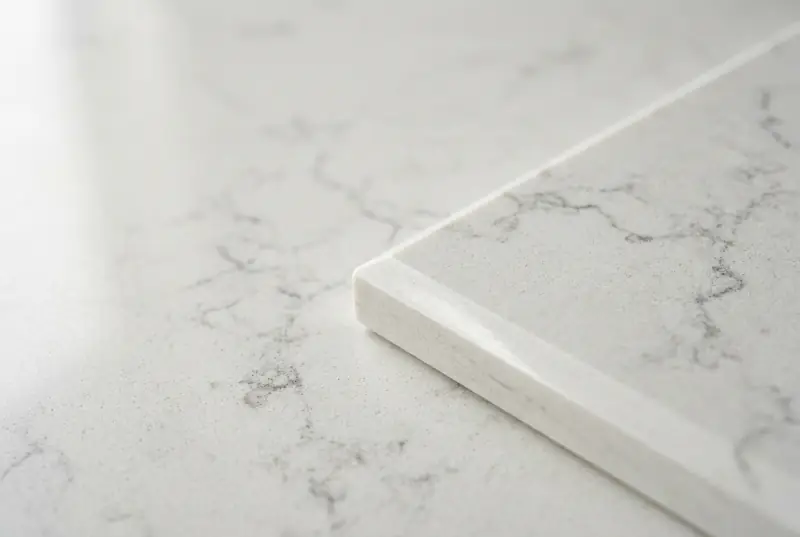
How is engineered stone made?
Quartz granules of mixed sizes and a fine quartz filler are mixed with a hardening resin, compacted by vibration under vacuum, and cured. Patent literature puts the quartz or cristobalite content at 50 to 95% by weight.
A 2020 study measured 91% crystalline silica in two commercial slabs and 9.6% in a third. NIOSH gives more than 90% for engineered stone, against less than 45% for granite.
What do slab makers check?
- The grading of each grit fraction, and the fineness of the powder, often as D50 and D90.
- Whiteness and colour. In a white slab, the quartz is most of what you see.
- Fe2O3, because iron affects colour.
- Moisture.
- Colour consistency from lot to lot.
We found no published standard for the quartz that goes into engineered stone. The European standards cover the finished product: EN 14618 for terminology and classification, EN 15388 for vanity and kitchen tops, and EN 16954 for flooring and stairs. Limits for the raw quartz sit in each buyer’s own specification.
Which rules affect engineered stone in 2026?
| Market | Status | Source |
|---|---|---|
| Australia | Use, supply and manufacture of engineered stone benchtops, panels and slabs prohibited from 1 July 2024 in most jurisdictions. The rules define engineered stone as containing 1% or more crystalline silica. | WHS ministers (2023); ACT explanatory statement |
| California | Cal/OSHA discussion draft to prohibit fabrication and manufacture of artificial stone with more than 1.0% crystalline silica. Comments closed on 30 September 2026. Not adopted. | Cal/OSHA |
| United Kingdom | No ban proposed as of June 2026. HSE says dry cutting is not acceptable and is inspecting fabricators. | Hansard; Stone World |
| United States | OSHA permissible exposure limit for respirable crystalline silica: 50 µg/m³ over 8 hours. OSHA and NIOSH updated their countertop hazard alert in 2026. | OSHA; AIHA |
Slab makers have responded with lines that contain less crystalline silica, some below 1%. For a quartz supplier, the destination market now matters as much as the specification.
Where does crushed vein quartz fit?
- Engineered stone uses both product forms: graded grits for the body and milled powder as the filler.
- Iron affects colour, so ask for Fe2O3 on every batch and check colour on a trial slab.
- Respirable crystalline silica is a hazard wherever quartz powder is handled or slabs are cut. IARC classifies crystalline silica, inhaled as quartz or cristobalite from occupational sources, as a Group 1 carcinogen.
What should a request include?
- Size fractions for each grit, and D50 and D90 for the powder.
- Whiteness or colour values (L*, b*) and the tolerance between lots.
- Fe2O3 and moisture limits, with the method.
- The markets your slabs are sold in.
- Monthly volume per fraction and destination port.
What we supply
We supply quartz grits in the fractions you set and quartz powder to your mesh or micron grade, both from Sri Lankan vein quartz. Each batch ships with a Certificate of Analysis reporting SiO2, Fe2O3, Al2O3, TiO2, CaO, Na2O, K2O, moisture and particle-size distribution. Send your specification and we tell you what we can hold from shipment to shipment.
Sources
- US patent US11891333B2, artificial agglomerate stone
- Carrieri et al., International Journal of Environmental Research and Public Health (2020)
- NIOSH Science Blog (2019), silicosis in countertop fabrication
- BSI, EN 14618, Agglomerated stone: terminology and classification
- BSI, EN 15388, Agglomerated stone: slabs and cut-to-size products for vanity and kitchen tops
- EN 16954:2018, Agglomerated stone: slabs and cut-to-size products for flooring and stairs
- Australian WHS and workplace relations ministers, communiqué of 13 December 2023
- ACT Legislation Register, explanatory statement on the engineered stone prohibition (2024)
- Cal/OSHA, respirable crystalline silica rulemaking 2026
- UK Parliament, Westminster Hall debate on workplace exposure to silica dust, 2 June 2026
- Stone World (2026), HSE action on engineered stone fabricators
- OSHA 29 CFR 1910.1053, Respirable crystalline silica
- AIHA (2026), OSHA and NIOSH countertop fabrication hazard alert
- Los Angeles Times, lower-silica countertop options (syndicated copy)
- CAREX Canada, crystalline silica profile (IARC Group 1)
Industry context. Figures on this page describe common industry practice and published standards, from the sources listed. They are not a specification for our material. Our values are on each batch COA. Published October 2026.