In short. Water treatment buyers specify filter sand by effective size, the sieve opening that passes 10% of the sand, and uniformity coefficient, the d60 size divided by the d10 size. State rules in Louisiana and Minnesota set 0.45 to 0.55 mm and 1.65 or less for rapid gravity filter sand. Crushed quartz can make filter sand, since angular grains give a more porous bed, but codes ask for rounded grains in support gravel.
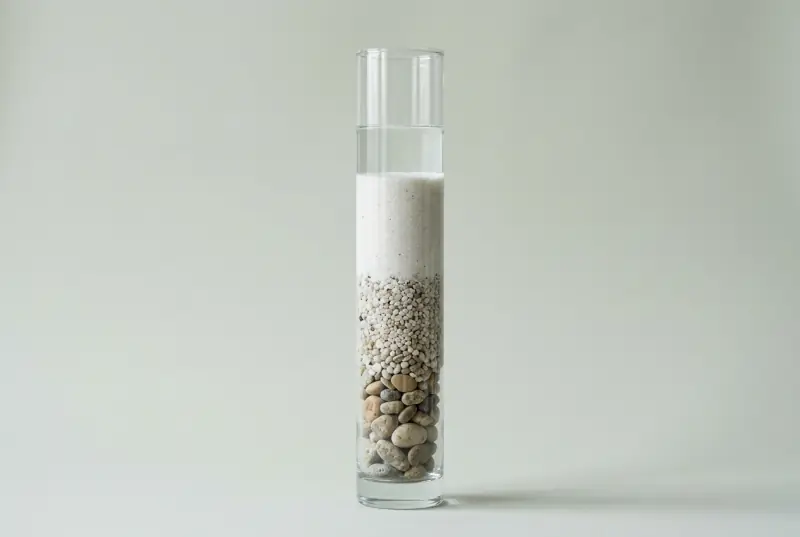
What does filter sand do?
A sand filter holds back suspended solids as water passes through a bed of graded grains. The bed sits on layers of graded support gravel.
What do water treatment buyers check?
| Parameter | Typical industry figure | Source |
|---|---|---|
| Effective size, rapid gravity filter sand | 0.45 to 0.55 mm | Louisiana; Minnesota rules |
| Uniformity coefficient, rapid gravity filter sand | 1.65 or less | Louisiana; Minnesota rules |
| Slow sand filters | Effective size 0.15 to 0.30 mm, uniformity coefficient 2.5 or less | Louisiana rules |
| Rapid filter sand, Japan | Effective size 0.45 to 0.70 mm, uniformity coefficient 1.7 or less | JWWA A 103-1 |
| HCl solubility | 3.5% or less | JWWA A 103-1 |
| Density | 2.57 to 2.67 g/cm³ | JWWA A 103-1 |
| Abrasion loss | 3.0% or less | JWWA A 103-1 |
| Specific gravity, support gravel | 2.5 or more | San Diego §13229, to AWWA B100 |
| Flat or elongated pieces, support gravel | 3% or less | San Diego §13229 |
| Common UK grading | 0.5 to 1.2 mm | BGS (2020) |
Which standards apply?
- AWWA B100-25, Granular Filter Material. A 2025 revision proposed changes to the specific gravity requirements and tests.
- EN 12904:2005, silica sand and silica gravel for treatment of water intended for human consumption. A revision started in October 2025.
- EN 12902, test methods for inorganic supporting and filtering materials.
- NSF/ANSI/CAN 61, health effects of materials in contact with drinking water, filter media included. It covers what leaches into the water, not filter performance.
- JWWA A 103-1, filter sand for water supply in Japan.
If a project requires NSF/ANSI/CAN 61 or EN 12904 conformity, say so in the request. We do not claim either.
Where does crushed vein quartz fit?
- For the same grading, angular grains give a more porous bed and a slower rise in head loss than round grains.
- Support gravel is different. US codes and city specifications ask for hard, durable, rounded particles, which crushed gravel does not meet.
- Filter media must be free of fines, and very friable grains should be avoided. Our process is dry, so tell us your fines or turbidity limit and we tell you whether we can meet it.
What should a filter sand request include?
- Effective size and uniformity coefficient, or a size band in millimetres.
- HCl solubility, with the method.
- Specific gravity or density.
- An abrasion or friability limit.
- A fines or turbidity limit.
- Any NSF/ANSI/CAN 61 or EN 12904 requirement.
- Monthly volume and destination port.
What we supply
We supply quartz grits crushed and screened from Sri Lankan vein quartz to the size band you set. Each batch ships with a Certificate of Analysis reporting SiO2, Fe2O3, Al2O3, TiO2, CaO, Na2O, K2O, moisture and particle-size distribution. Send your specification and we tell you what we can hold from shipment to shipment.
Sources
- Louisiana Administrative Code 51:XII §177, filter media
- Minnesota Rules 4720.3945, filter media
- City of San Diego, specification §13229, filter media
- JWWA A 103-1 filter sand requirements, as published by Tohkemy
- British Geological Survey, Mineral Planning Factsheet: Silica Sand (2020)
- AWWA B100-25, Granular Filter Material
- AWWA, notice on the B100 revision
- EN 12904:2005, silica sand and silica gravel for treatment of water intended for human consumption
- DIN, prEN 12904 revision project (2025)
- EN 12902, inorganic supporting and filtering materials: methods of test
- NSF, NSF/ANSI/CAN 61 Drinking Water System Components: Health Effects
- SUEZ Degrémont Water Handbook, filtration through a granular bed
Industry context. Figures on this page describe common industry practice and published standards, from the sources listed. They are not a specification for our material. Our values are on each batch COA. Published October 2026.